
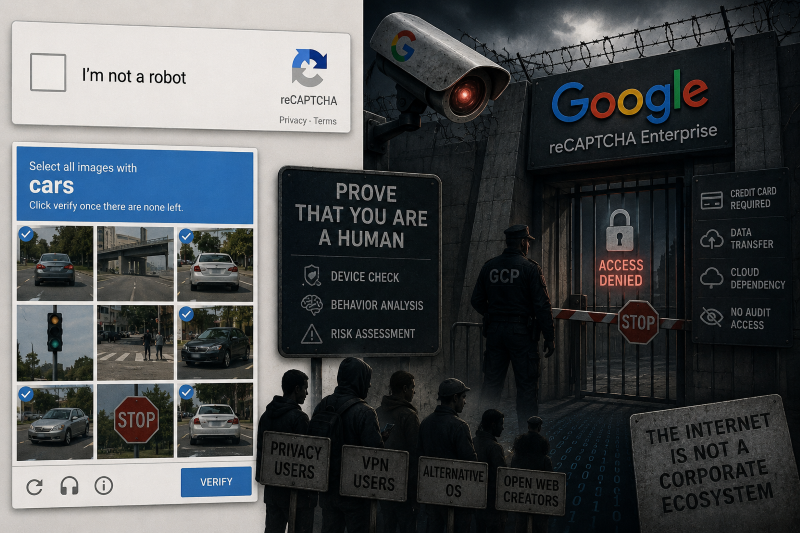
“Prove that you are a human,” or “Click on all the images of cars”. Familiar phrases like these have been part of everyday internet life for a long time. Using these reCAPTCHA tools, Google has long acted as a digital gatekeeper, ensuring that the fingers on the device are those of a genuine human and keeping malicious bots at bay. Now, Google’s platform is undergoing a transition phase.
Google has made major changes to its widely used security tool, reCAPTCHA. What used to be a simple web widget is now fully part of the Google Cloud Platform (GCP) ecosystem.
While corporate narratives tout this step as necessary progress in cybersecurity, developers of privacy-focused Android systems, civil society organizations, and digital rights & privacy advocates such as the European Pirates and European Digital Rights (EDRi) see a far more alarming reality. This marks a shift in the fundamental architecture of web access, introducing systemic legal changes, economic gatekeeping, and technological exclusion.
At the center of this transformation lies a larger global shift driven by artificial intelligence. As AI systems become increasingly capable of mimicking human behavior online, corporations are restructuring how trust, access, and verification operate across the internet. Critics argue that the result is an internet where participation increasingly depends on compliance with opaque corporate ecosystems rather than open standards.
The New Architecture: What Has Changed?
The rules for how reCAPTCHA works have been completely changed, taking control away from regular website owners and users.
-
Mandatory Cloud Integration & Billing: Google has ended support for all old “Classic” reCAPTCHA accounts on Google Cloud Platform. To continue using reCAPTCHA, website owners must migrate to the Google Cloud Platform. Even though there is still a free option for smaller sites, one has to link a valid credit card or billing account to activate it.
-
The Legal Liability Loophole: Under the proposed changes, Google’s role shifts from a “data controller” to a “data processor,” with the entire onus of user tracking placed on individual website operators.
-
Device Attestation Locks: The security system is now closely tied to Google Play Services on Android. Devices that use alternative, uncertified, or privacy-focused operating systems (like custom ROMs) will not pass background checks and will be blocked from accessing protected websites.
The Corporate Rationale: The Defense of Infrastructure
To fully dissect the issue, one must understand the justification driving Google’s infrastructure overhaul.
-
Combating Advanced Botnets: Automated scripts and bots have become increasingly sophisticated. Many now use artificial intelligence to get past old text or image puzzles.
-
Enterprise Security Scaling: By making reCAPTCHA part of Google Cloud’s broader Fraud Defense tools, Google provides large companies with analytics that can help stop large, organized fraud attacks.
-
Data Ownership Framing: From Google’s perspective, handing over complete control of data to website operators grants businesses ultimate authority and governance over how their visitors’ security telemetry is compiled and managed.
Amidst a flurry of such proposals circulating every second day aimed at changing the face of internet operations, it is important to note that AI has changed the scale of online automations. The aforementioned change by Google marks a shift from simple spam filters to large-scale behavioral surveillance systems that continuously evaluate “trustworthiness” in the background.
The question is: will this change to the definition of “trusted user,” based on a behavioral algorithm, keep the internet accessible and safe for everyone?
The Counterarguments: The Case for Digital Rights
Civil society groups argue that Google’s explanation hides a bigger problem: the web is becoming more controlled by a few companies, and people are losing digital independence.
-
The Subversion of GDPR Spirit
By calling itself just a “processor,” Google puts the financial and legal risks on small businesses, open-source projects, and independent blogs. Website owners cannot check or control the hidden algorithms Google adds to their sites. Google benefits from user tracking to improve fraud detection, but regular web creators face legal problems if anything goes wrong.
-
Financial Identity Wall
Making people verify with a credit card to use basic web protection shuts some people out. Small creators, activist groups, and student developers have to give their financial information to a big tech company just to keep their sites safe from spam. This puts a barrier around the open web.
-
Algorithmic Discrimination against Privacy Users
With more “invisible” tracking, users can only access sites if they agree to be tracked. If someone uses privacy tools such as a VPN, tracking blockers, or a privacy-focused phone system like GrapheneOS, Google’s checks may flag them as suspicious. Real people are treated like threats just because they want privacy. This is especially unfair to journalists, whistleblowers, and privacy advocates who need special tools to stay safe.
-
Monopoly is the Motive
Many privacy-focused Android developers are concerned about the drastic economic impact that Google’s reCAPTCHA system update is set to bring about on millions of small websites. Brendon Eich, CEO of Brave Browser, expressed concern, stating that Google’s security concern is unfounded. The core idea is to maintain a monopoly through Google Mobile Services (GMS) licensing. The GrapheneOS team shares a similar view – the requirements set by Google and Apple services are more anti-competitive than security-focused.
Conclusion: Reclaiming Digital Freedom
Web security must not become a source of corporate tax. Individuals shouldn’t be made to compromise their financial identities or choose between web access and device autonomy. As Google hardens the borders of its proprietary cloud ecosystem, the need for decentralized, transparent, and privacy-respecting verification methods becomes a pressing structural necessity for a democratic internet.
Take Action: Speak at the Think Twice Conference (TT5)
Those seeking to challenge corporate gatekeeping and advocate for a transparent digital future will have an opportunity to join the discussion at the Think Twice Conference (TT5), hosted by the Pirate Parties International and the European Pirates.
This year’s conference theme focuses directly on AI & Governance: Opportunities and Risks for Digital Freedom, bringing together developers, activists, policymakers, and civil society groups to debate how automated systems can remain transparent, accountable, and aligned with human rights principles.
The official Call for Speakers is currently open for individual talks and panel roundtables.
The registration deadline for speaker applications is June 1, 2026.
As debates over AI, surveillance, and platform control intensify, events like TT5 are becoming increasingly important spaces for defending the future of a democratic and open internet.
0 comments on “Bouncers at the Digital Border: How Google’s reCAPTCHA Overhaul Fractures the Free Internet”