
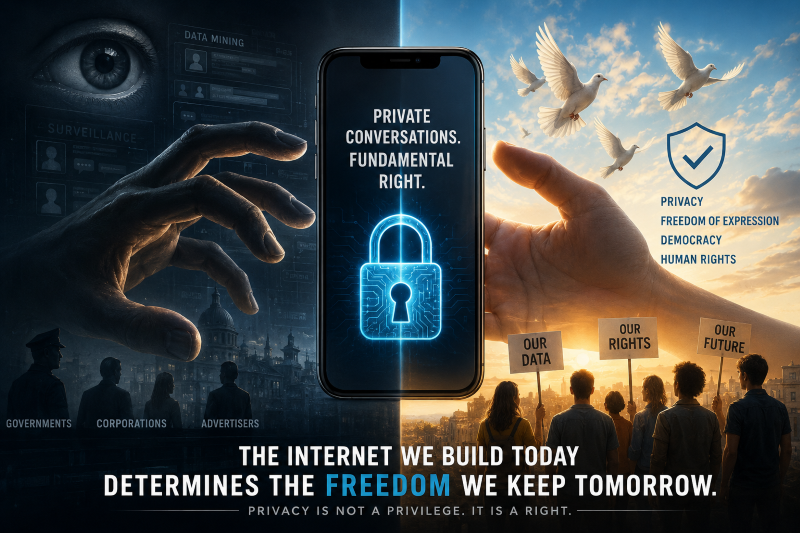
Etiquette says, “reading personal messages not addressed to you is improper and impolite.” But Meta’s decision to discontinue End-to-End Encryption for Instagram private and direct messages on 8th May 2026 raises concerns about crossing that line.
If this issue were only about personal behavior, the results would be straightforward: lost trust, public backlash, and maybe some new rules to remind us that privacy is important. But when a major company like Meta changes the meaning of private communication, the impact is much greater. Now, governments, advertisers, businesses, activists, journalists, and billions of users all face the same question:
Who gets access to our conversations, and at what cost?
What Exactly Is End-to-End Encryption?
End-to-End Encryption (E2EE) – a security feature that makes sure only the sender and recipient can read messages. No one else – not governments, law enforcement, hackers, or even the platform itself can access them.
Today, personal data is extremely valuable, so encryption is less of a luxury and more like a digital lock on your front door.
Meta’s Decision and What It Means for Users
Meta still uses end-to-end encryption on WhatsApp, so even the company cannot read those conversations. But now, Meta has chosen to remove this protection from Instagram direct messages.
For many privacy advocates, the move feels like a mailman opening confidential envelopes before they reach their destinations. And not just reading them, but also deciding which messages deserve attention, which appear suspicious, and whether they should reach the recipient at all.
The concern is not merely about discomfort. It is about power: who holds it, how much access they possess, and how easily the boundaries of privacy can shift once surveillance becomes normalized.
What Is Meta’s Argument?
To understand the debate, it’s important to know that Meta’s decision did not happen on its own.
The company has argued that very few users were actively opting into encrypted direct messaging features. According to a Meta spokesperson:
“Very few people were opting in to end-to-end encrypted messaging in DMs. Anyone who wants to keep messaging with end-to-end encryption can easily do that on WhatsApp.”
At the same time, Meta continues to face mounting scrutiny regarding child safety on its platforms.
In a lawsuit brought by New Mexico Attorney General Raúl Torrez, Meta was accused of failing to adequately protect users on Instagram and Facebook from online predators while continuing to portray its platforms as safer than they actually were.
The case raised more concerns. Internal records showed that employees knew stronger encryption on Messenger could make it much harder to report almost 7.5 million child sexual abuse material (CSAM) cases.
Because of these concerns, especially about child safety, some people see Meta’s decision as a needed step to better spot harmful content, scams, and abuse before it spreads on the platform.
For many people, especially parents and safety advocates, these concerns cannot simply be dismissed.
The Concerns Raised by Digital Rights Advocates
While Meta has defended its decision on safety and moderation grounds, digital-rights groups argue that the implications extend far beyond platform management.
- Removal of Vital Privacy Protections
One of the strongest objections raised by privacy advocates is the removal of a fundamental layer of digital protection.
Without E2EE, Meta can access direct messages, including texts, images, videos, and voice notes. Critics say this changes the meaning of private communication online. For activists, journalists, whistleblowers, and people in restrictive countries, encryption is not just a feature—it’s protection from surveillance and misuse of their information.
- Weakening Security Infrastructure
Cybersecurity experts and privacy groups have repeatedly warned that weakening encryption protections creates broader vulnerabilities across digital systems.
The concern isn’t just about Meta reading messages. Critics say that once secure systems are opened up, the risks of data breaches, hacking, and misuse go up. Many believe there’s no such thing as a truly safe backdoor into encrypted systems.
- Corporate and Ethical Concerns
Another major criticism centers around Meta’s commercial incentives.
Critics say that easier access to private messages could help Meta improve targeted ads and train AI models. Since private conversations hold a lot of personal and emotional information, this raises ethical questions about whether our messages should be used for profit.
Activists also question Meta’s claim about “low adoption” of encrypted features like Secret Conversations. They argue that these features were hard to find and hidden in menus, so low usage was more about design than lack of interest.
- A Dangerous Precedent
Privacy advocates also fear that Meta’s decision could influence broader industry behavior.
Meta is one of the world’s biggest tech companies, and other platforms often follow its lead. Critics worry that if Meta weakens encryption, it could make lower security standards normal across social media.
For digital-rights defenders, this is not merely a platform-specific policy change. It could become a turning point for the future of online private communication.
- The Limits of Surveillance-Based Safety
Child safety organizations and some policymakers have welcomed Meta’s move, arguing that End-to-End Encryption can make it harder to detect abusive networks and harmful content.
However, privacy advocates say that removing encryption doesn’t eliminate threats to vulnerable users. Instead, it takes away protection from everyone and puts more pressure on victims to spot and report abuse themselves.
Critics also warn that surveillance systems introduced in the name of safety can gradually expand beyond their original purpose if sufficient safeguards and accountability are absent.
- Contradicting the “Future Is Private” Promise
For many critics, the decision also represents a major credibility issue.
In 2019, Mark Zuckerberg publicly stated that “the future is private,” signaling a broader shift toward secure and encrypted communication across Meta’s platforms.
The current rollback is therefore being viewed by many digital-rights advocates as a direct contradiction of that earlier promise.
Will This Normalize Surveillance?
As part of a collective redress, several digital-rights organizations and civil society groups have publicly opposed Meta’s decision through a coalition led by the Global Encryption Coalition. Member groups include European Digital Rights, Mozilla, Global Partners Digital, Internet Society, and Internet Freedom Foundation.
Their deepest concern is not just the immediate policy change, but the cultural shift it represents.
Over the last decade, people have gradually become accustomed to trading privacy for convenience. Location tracking, targeted advertising, algorithmic profiling, and facial recognition systems all entered public life slowly enough to feel almost inevitable. Critics fear encryption could be next.
If societies begin accepting the idea that private communication must always remain accessible to monitoring or inspection, privacy itself slowly ceases to be treated as a right and becomes a suspicious privilege.
The fear of always being watched could have lasting effects on free speech, democracy, and independent journalism. Many privacy advocates say that the idea of “nothing to fear if nothing wrong has been committed” misses the point because it treats privacy as secrecy instead of a basic right.
Is There a Middle Ground?
The debate between safety and privacy remains deeply complex. Concerns raised by parents, safety advocates, and law enforcement agencies cannot simply be brushed aside. Preventing abuse, scams, and harmful content is an important responsibility for digital platforms and society at large.
At the same time, users increasingly fear a future where private conversations are no longer truly private. This tension has pushed researchers, cybersecurity experts, and policymakers to explore possible middle-ground solutions where safety measures can coexist with stronger privacy protections.
Some methods, such as client-side scanning, try to detect harmful material before messages are encrypted. Other approaches, such as differential privacy, federated learning, and privacy-preserving computation, aim to make safety systems better without exposing personal data.
However, digital-rights advocates remain cautious. Critics argue that even privacy-focused monitoring systems can gradually evolve into broader surveillance mechanisms in the absence of strong safeguards and accountability. The concern is not just whether these technologies function effectively, but who controls them and how their powers may expand over time.
Conclusion
People rarely think about the importance of encryption until it begins to disappear.
Imagine living in a world where someone could hear your inner thoughts without permission. At first, such a power might seem fascinating. But over time, the freedom to think, question, disagree, or express yourself honestly would begin shrinking under the fear of constant observation.
Privacy functions similarly.
The current debate surrounding Meta is therefore broader than a single company or a single policy decision. It reflects a broader struggle over what kind of internet we are collectively building: one centered on user rights and democratic freedoms, or one increasingly shaped by surveillance, control, and data access.
The outcome could shape not only the future of online communication, but also the limits of digital freedom itself.
Care to answer and act?
Is merely knowing how the digital world is changing enough? Is awareness of our rights to privacy, expression, and opinion sufficient to protect them? Does the responsibility of a digitally aware citizen end at simply observing how digital policies shape our online lives?
If the answer is NO, then it is time to act.
Join European Pirates in defending an internet where security does not come at the cost of freedom and privacy.
Pingback: Between Agency and Determinism, Who Holds the Wheel in Digital Society? – European Pirates