
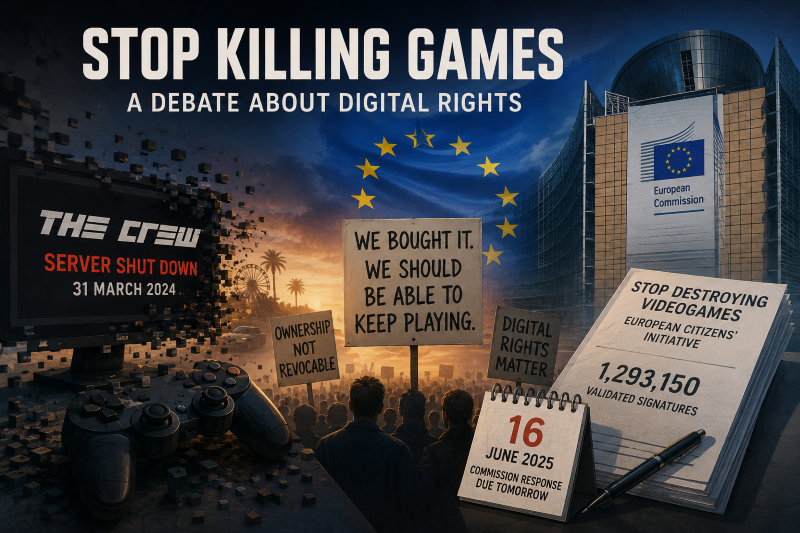
What happens when a company can make a product disappear after consumers have paid for it?
This question left gaming forums and reached the European Commission after Ubisoft shut down The Crew on 31 March 2024. With the Commission set to respond to the Stop Killing Games initiative on 16 June, campaign organizers have released an open letter. They are worried about how the movement is being portrayed as the process nears its end.
On 31 March 2024, Ubisoft shut down The Crew, a game originally designed to be always online. The foundation for this action was laid in December 2023 when Ubisoft announced that after 31 March 2024, the game would no longer be accessible to players. On 1 April, the game was completely shut down, with a message from Ubisoft saying:
“We understand this may be disappointing for players still enjoying the game, but it has become a necessity due to upcoming server infrastructure and licensing constraints.”
While The Crew’s shutdown sparked the Stop Killing Games movement, worries about vanishing digital games existed before. Earlier closures like Darkspore (2016), Battleborn (2021), and Babylon’s Fall (2023) had already concerned preservationists and consumer advocates.
Following The Crew‘s shutdown, Ross Scott, an American YouTuber, initiated the Stop Killing Games movement. Stop Killing Games is a consumer-rights campaign advocating that video games remain playable after publishers shut down official servers. The cornerstone of this argument is the treatment of games as purchased products rather than revocable subscriptions.
The movement rapidly spread beyond gaming circles. Digital rights organizations, consumer rights advocates, preservation groups, and right-to-repair supporters joined the discussion. What began as a debate about video games gradually evolved into a broader conversation about ownership in the digital age.
That shift saw a breakthrough in July 2024, when supporters launched the European Citizens’ Initiative (ECI), “Stop Destroying Videogames.”
Unlike an ordinary petition, a successful European Citizens’ Initiative obliges the European Commission to examine the proposal and issue a formal response. The initiative quickly gained traction across the European Union.
A simple complaint and petition grew into a topic for European policymakers. The movement gained support in 24 EU countries and collected over 1.3 million signatures before verification across the EU, easily passing the required threshold. This made it one of the most successful European Citizens’ Initiatives in recent years and showed that digital consumer rights matter to many people, not just the gaming community.
The Road to Brussels
Since achieving the required threshold, the initiative has entered the formal EU process.
Organizers met with European Commission officials in February 2026 to present their arguments. A public hearing followed at the European Parliament in April, where lawmakers questioned organizers and discussed potential regulatory approaches. The initiative was later debated during a plenary session of the European Parliament, bringing questions of digital ownership and consumer rights into mainstream European political discourse.
The next major milestone arrives tomorrow, 16 June, when the European Commission is going to publish its official response to the initiative. While there is no obligation for the Commission to propose legislation, it must formally explain what action it intends to take – or why it chooses not to act.
SKG’s Open Letter – What It Is Really About
At its core, the SKG’s open letter to the community is a response to a crucial moment in the campaign’s journey, when the Stop Killing Games initiative moves from public debate into final political decision-making at the European level.
The recent Stop Killing Games letter focuses less on game preservation itself and more on concerns regarding representation during this crucial phase of the process.
The letter points to the fact that senior European Commission officials attended a private event together with Ubisoft CEO Yves Guillemot, organized by the industry group Video Games Europe, shortly before the Commission’s response was due. To no surprise, no one from the SKG movement was invited to participate.
For supporters, the issue is not that industry representatives were consulted. In any legislative process, businesses affected by potential regulation are expected to present their views.
The concern is that the voices behind the initiative are being given the same level of access and consideration as industry representatives.
The letter represents the fear of “what if despite following the prescribed procedure the voices remain unheard in the final stages of decision making”.
The timing of the meeting is pivotal to the movement’s concerns. With the Commission’s response imminent, supporters argue that policymakers should hear directly from the citizens who backed the initiative rather than relying primarily on industry interpretations of its goals.
The letter also says the campaign’s proposals have often been misunderstood. Organizers claim that Stop Killing Games is sometimes described as asking for never-ending server maintenance, constant developer support, required source code releases, or forced private servers.
The organizers reject these characterizations.
Their actual position is much narrower: if a company ends support for a game, consumers should still have access if there is a reasonable technical solution. In short, supporters want publishers to plan for the end of a game’s life, not just shut it down completely.
This distinction has become increasingly important as the campaign moves from public advocacy into legislative discussions.
Support Inside the European Parliament
The initiative has attracted support from lawmakers across multiple political groups.
Markéta Gregorová, Member of the European Parliament for the European Pirates, is among the most vocal supporters of stronger consumer protections for digital products. European Pirates have long campaigned on issues such as digital rights, interoperability, right-to-repair legislation, open standards, and protections against planned obsolescence.
More recently, a cross-party coalition of MEPs has also called for legislative action following the initiative’s success, arguing that the concerns raised by more than 1.29 million validated supporters deserve a serious response.
Their support reflects a broader shift in the debate. What was once viewed as a gaming issue is increasingly being discussed alongside wider questions about consumer rights in a digital economy.
More Than a Gaming Debate
Perhaps the most important takeaway from the Stop Killing Games letter is that it reframes the discussion.
The central question is no longer whether an old video game should remain playable.
Instead, it asks something much larger:
What does ownership mean in a world where products can be remotely altered, restricted, or disabled?
For the European Pirates and everyone else supporting the Stop Killing Games Movement, it is clear that the answer should not depend entirely on a corporation’s continued goodwill.
As the European Commission prepares to publish its response on 16 June, the outcome’s impact will extend beyond the future of video games. It will influence broader conversations about digital ownership, consumer protection, and the rights people retain after clicking the “Buy” button.
Like the number of years of software updates for modern mobile telephones. Even if a model doesn’t become popular, there is a need for a contingency plan for security upkeep. That would then be parallel feedback into a minimal working copy of a game, or a communicated plan for its availability before purchase, resulting in openness about the lifecycle management of the products we buy.
The coming days may determine whether Stop Killing Games becomes a landmark moment in digital rights policy or simply the beginning of a much longer conversation.
0 comments on “Stop Killing Games: Why a Movement About Video Games Has Become a Debate About Digital Rights”