
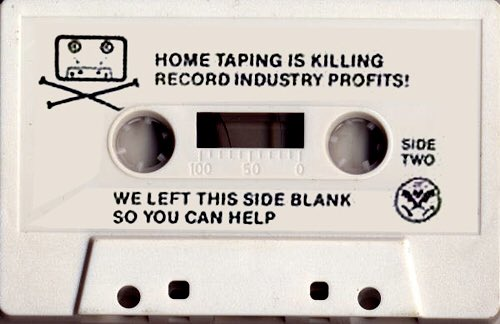
Someone once spent an evening choosing the order of twelve songs, wrote the titles on the paper insert by hand, and gave the cassette to a person they were hoping to impress. It was a copy. It was made without asking anyone. Across much of Europe it also fell squarely within an exception that lawmakers had gone out of their way to create.
That was not an oversight. Germany wrote a private copying exception into its Copyright Act in 1965 and paid for it with a levy on recording equipment and blank media. Most of continental Europe followed the same model, and the arrangement was eventually carried into EU law as the private copying exception in Article 5(2)(b) of the InfoSoc Directive — the 2001 law that still governs copyright across the European Union. Rightsholders were compensated. Nobody had to be watched.
The record industry campaigned against it anyway. “Home taping is killing music” was the British Phonographic Industry’s slogan from 1981, printed on record sleeves under a skull-and-crossbones. It is worth noticing what that campaign did with language: an act that European lawmakers had deliberately permitted, and for which artists were already being paid through the levy, was described as killing. The framing arrived two decades before file-sharing became a mass phenomenon — the first clue that the argument was never really about the copying.
Two answers, and the one that travelled
Europe and the United States faced the same question in the cassette era and answered it in opposite ways.
Europe legalised the copying and paid for it collectively. Levies on recording equipment and blank media flow through collecting societies to authors, performers, publishers and visual artists. According to the global study published by the collecting societies themselves, the system now operates in 31 European countries against four in the whole of the Americas, generates over €1 billion a year worldwide, and costs each consumer between €1.14 and €3.19 annually. In more than twenty countries part of the money funds social and cultural programmes — training, pensions, support for emerging artists — which is why this is better understood as social infrastructure than as a tax. The Court of Justice has held that up to half of such compensation may be directed to those institutions. And the study describes the defining feature of the whole arrangement in a single phrase: the money reaches creators “without monitoring individual users.”
The system has real critics. Europe’s technology industry argues that levies are an outdated instrument that charges buyers for copies many of them never make, applied through tariffs that vary widely and unpredictably between Member States. That is a fair objection to how the levy is calculated. It is not an argument against the principle underneath it.
The United States built nothing comparable. Its Audio Home Recording Act of 1992 did create a royalty, but only on dedicated digital audio recording devices — and when the recording industry tried to apply it to the first MP3 players, the Ninth Circuit held in RIAA v. Diamond Multimedia (1999) that the Rio was not such a device, because it merely made portable what was already on a computer’s hard drive. General-purpose computers fell outside the scheme, and the scheme never recovered. One comparison put annual private copying payments at $1.2 billion in the EU against roughly $1 million in the United States.
With no mechanism to compensate for copying, there was nothing to offer in exchange for permitting it. The American answer to home copying could only be to prevent it. That answer was written into the WIPO Copyright Treaty in 1996, into the Digital Millennium Copyright Act in 1998, and then into European law in the InfoSoc Directive of 2001 — the very directive that codified the private copying exception. Europe kept its levy and imported the lock in the same instrument.
Europeans consequently pay twice. The levy is charged on the device on the assumption that private copies will be made. The DRM on the file then prevents the copy the levy has already paid for.
Canada shows where that combination ends. It adopted the European model in 1997, with a private copying exception for music funded by a levy — but the statute named media rather than devices. When the Copyright Board extended the tariff to the memory inside MP3 players, the Federal Court of Appeal struck it down for want of authority, and the Supreme Court declined to intervene. The levy stayed on blank CDs while the copying moved to phones, and receipts fell from C$38 million in 2004 to C$1.1 million in 2019. Canada then implemented the anti-circumvention rules in 2012 regardless, alongside a set of user exceptions more generous than anything in EU law — format-shifting, backup, and a non-commercial remix exception Europe still lacks — all of which the digital locks override. The lesson is worth stating precisely: the Canadian levy did not fail because collective compensation does not work. It failed because a statute written around cassettes was never rewritten.
The companies that came to operate the distribution layer grew up under the American rule set rather than the European one. Apple’s iTunes Store, Amazon’s Kindle, Google’s YouTube, Netflix and Steam determine the terms on which most Europeans now reach music, books, film and games, with Spotify the notable European exception. The safe harbour that made platforms built on user uploads commercially viable was an American design. Europe’s eventual answer, Article 17, imposes filtering costs — Google says it has invested over $100 million in Content ID alone — that in practice only the largest incumbents can absorb.
Meanwhile the European mechanism erodes. Levy collections across 32 countries have been broadly flat in cash terms since 2017 and have fallen in real terms, because the copying has moved to streaming, where the exception, and the payment attached to it, does not clearly reach.
The copy you cannot give away
Buy a paperback and it is yours. Resell it, lend it, give it away, leave it to someone in a will — copyright does not stand in the way, because the right to control distribution of that copy is exhausted by the first authorised sale. This is not a loophole. Exhaustion is the mechanism that makes libraries, second-hand shops and gifts possible.
Buy the same book as an e-book and none of it holds. In Tom Kabinet (C-263/18, 19 December 2019), the Court of Justice of the European Union ruled that supplying an e-book for permanent download is not “distribution” at all but “communication to the public” — a right that is never exhausted. A second-hand market in e-books is therefore unlawful without the publisher’s permission. The Court had reached the opposite conclusion for downloaded software seven years earlier, in UsedSoft (C-128/11), which tells us the distinction is a policy choice rather than a fact of nature.
No piracy is involved anywhere in this. A reader who paid full price cannot pass the book on. What was removed was not an unauthorised act but an ordinary one.
The lock that outranks the right
The private copying exception still exists on paper. Exercising it is another matter.
The anti-circumvention rules imported in 2001 make it unlawful to defeat a technological protection measure — the family of access controls usually called DRM. Article 6(4) was meant to be the safety valve between the two halves of the directive: Member States should ensure that people can still benefit from certain exceptions even when a work is locked. In practice it applies to a closed list of exceptions, leaves the remedy to national procedures that most Member States never built, and offers nothing at all where a work is streamed on demand.
The result is a right that cannot be exercised. The lock wins, and the lock does not distinguish between an infringing copy and a lawful one — it cannot, because it does not know what the user intends.
Portugal is the exception that proves the point. Law 36/2017 permits circumvention where the purpose is to exercise a lawful exception, and forbids DRM on public domain works and on works funded by public money. Campaigners there needed fifteen years to win a right that the Directive had always claimed to guarantee.
Enforcement moved into the pipes
Article 17 of the 2019 Copyright in the Digital Single Market Directive made large platforms liable for what their users upload unless they make best efforts to prevent it. It was argued for as a fix to the “value gap” between what platforms earn and what rightsholders receive. What it requires in practice is automated inspection of everything anyone posts.
The Court of Justice upheld the provision in Poland v Parliament and Council (C-401/19, 26 April 2022), but not in the form several governments wanted. It rejected the argument that content could be blocked systematically at upload so long as users could appeal afterwards, and held that safeguards must operate before blocking, not after. A filter that cannot tell a quotation from an infringement may not be deployed as though it can.
That judgment is a genuine win for user rights. It is also an admission about the mechanism: the default behaviour of automated enforcement is to remove lawful speech, and it took the EU’s highest court to say so.
When there is no copy at all
The clearest case is the one currently on the table.
The European citizens’ initiative “Stop Destroying Videogames” was submitted to the Commission on 26 January 2026with 1,294,188 verified signatures. It asked for something modest: that a game sold to the public should be left in a playable state when the publisher stops supporting it. On 16 June 2026 the Commission replied that it cannot at this stage propose such an obligation, and offered instead to convene the industry on a voluntary code of conduct by the end of 2026.
The background to that request is Ubisoft’s racing game The Crew, delisted in December 2023 and switched off three months later. Buyers then found their licences revoked outright. In the litigation that followed — including a case brought by the French consumer association UFC-Que Choisir — Ubisoft’s defence was that customers had never bought a copy at all, only a limited licence to access a service.
That defence is legally coherent, and that is precisely the problem. When the transaction is a licence rather than a copy, there is nothing to lend, resell, archive or hand to anyone. The unmonitored exchange of culture between people does not have to be prohibited. It simply has nothing left to move.
The case on the other side
It deserves stating properly. Creators need income, and an unlimited right to copy and redistribute commercially would remove the market that pays them. Rightsholders cannot realistically police millions of individual users, so building enforcement into infrastructure is a rational response to a real problem. Licensed streaming has been a genuine success on its own terms: cheap, legal and convenient, and its defenders can fairly point out that it did more to draw people away from unauthorised downloading than a decade of lawsuits ever managed.
None of that is in dispute. The question is what the mechanisms actually deliver.
Extending the term of protection for sound recordings from 50 to 70 years, as the EU did in 2011, prevents no unauthorised copying whatsoever — it can only extend control over recordings that already exist. A study prepared for the European Parliament sets out the recurring criticism: the benefit falls mainly to labels and a small number of successful performers, while ordinary session musicians have little bargaining power over the contracts that determine what reaches them. The levy that paid for the mixtape paid artists directly. Digital rights management, upload filters and licence-only distribution do not pay them more; they change who decides on what terms a work reaches the public.
That is the reform question. Not whether creators should be paid — they should, and better than they currently are — but who holds the switch.
What reform actually asks for
The European Pirates’ programme states the position directly:
- Non-commercial use is protected, not merely tolerated. “Copying, storing, using, and providing access to literary and artistic works for non-commercial purposes must not only be legalized but protected by law.” Non-commercial file sharing should be allowed.
- Shorter commercial terms. The term of the commercial monopoly should be further shortened, exclusive rights must be limited in time and scope, and neither may be expanded retrospectively.
- Derivative and everyday uses carved out. Remixing, parody, quotation and sampling exempt from the commercial monopoly; derivative works permitted by default, with exceptions written explicitly into law; linking never an infringement.
- Exceptions made mandatory across the EU, so that a lawful use in one Member State is not an infringement in the next.
- Public money, public access. Cultural heritage digitised and made available free of charge; an end to the privatisation of profits from publicly funded works.
- Transparency from collecting societies, and fair contract terms for the artists on whose behalf all of this is said to be done.
Four further steps follow from the mechanisms described above, and are where the argument now runs. A right to circumvent DRM where the purpose is a lawful one, together with a ban on DRM applied to public domain works and works funded from public money, on the Portuguese model. Digital exhaustion, so that a purchased digital copy can be resold, lent, given away and inherited like its physical equivalent. An end-of-life duty, so that a work withdrawn from sale is left usable rather than switched off — the ask that 1.29 million Europeans have already signed. And a collective compensation mechanism that survives the shift away from physical media, because the European alternative to controlling users was always to pay creators without watching them, and that half of the bargain is the half currently being allowed to lapse.
Some of this is live now. The Commission’s Digital Fairness Act, expected in the second half of 2026, is where the question of what a consumer actually owns when they buy something digital will next be argued.
The point
The mixtape was not a legal grey area that technology happened to close. It was a settled European compromise, and a deliberate one: culture could move between people without permission and without a record, and creators were paid for it through a mechanism that required watching nobody. Europe had built the thing the digital debate is still said to be searching for — a way to pay creators that does not depend on controlling what individuals do with what they own.
Then it adopted, on top of that mechanism, a legal architecture designed elsewhere for a country that had never built one. Every measure since has chipped away at one half of the European compromise while leaving the other half unimproved, and the half that erodes is the one that pays artists. Pirates want copyright reform not because copying should be free of consequence, but because a law written to reward authors has been rebuilt, piece by piece, into a system for deciding who may hand what to whom — and that is a different thing entirely.
Read more on our position, to support the review of the 2019 Copyright in the Digital Single Market Directive in the light of the even more modern advances in technology, below.
0 comments on “Why Pirates want Copyright Reform”