The new EU KIDS Act (EU Keeping Internet Digital Spaces Accountable and Trustworthy) could regulate the use of certain online services by minors, introducing age restrictions and mandatory age verification with the aim of protecting kids. Yet the main question is: is it proportionate?
Article 24 of the EU Charter of Fundamental Rights establishes that the best interests of the child must be a primary consideration in all actions concerning children. So, the aim of the proposal is to improve, promote and support respect for the rights of the child online and protect them from illegal content online, harmonizing the legal framework across EU Member States.
The key proposals of the Act
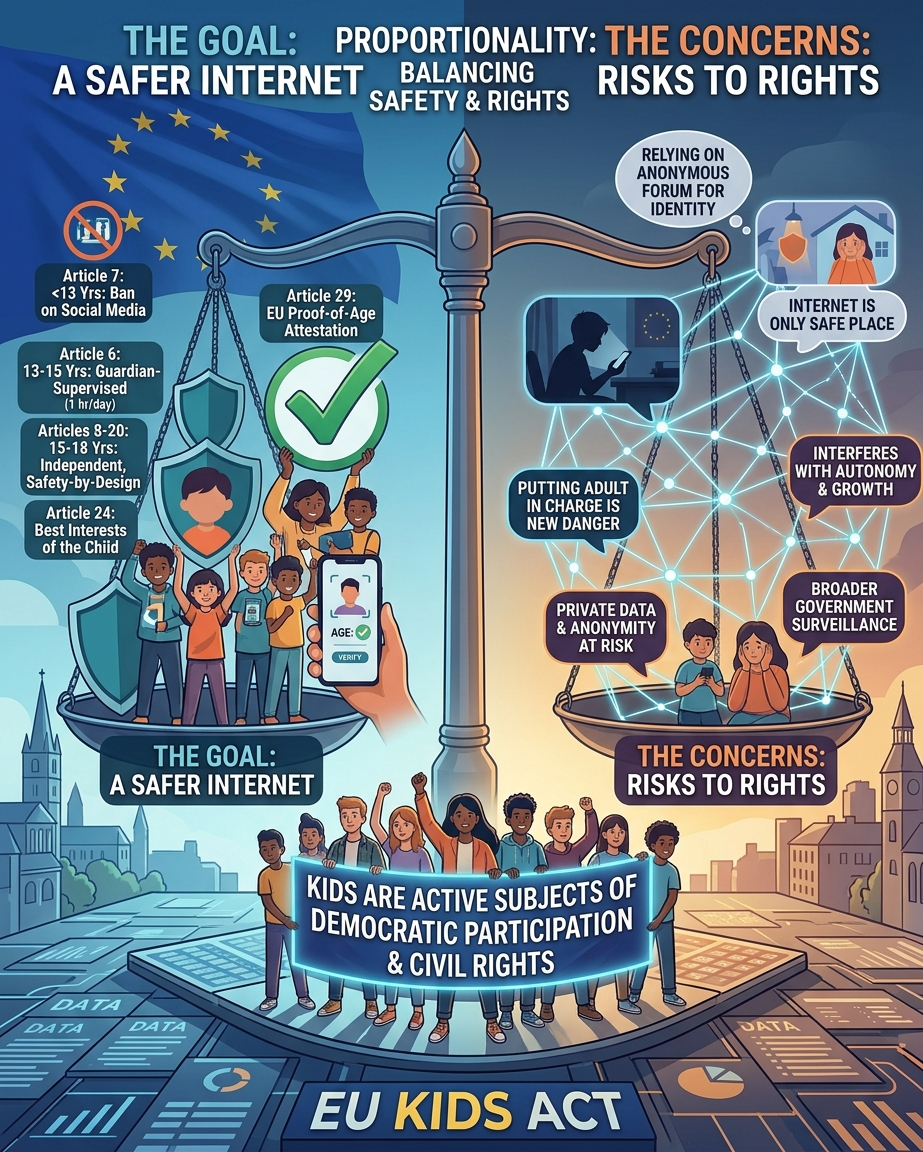
The proposal’s core points are Articles 6, 7 and 8–20, which harmonize minimum age requirements for creating an account:
- Article 6 imposes restrictions on independent accounts for kids aged 13 to 15. They could only access certain services through supervised mini-accounts linked to a guardian’s account, with a daily limit of 1 hour.
- Article 7 establishes a complete ban on social media accounts for kids under 13. Their access to the services covered by the provision could instead be limited to specific child-friendly video services managed through a guardian. Again, with a limit of 1 hour a day.
- Articles 8–20 allow minors aged 15 to 18 to have independent accounts without the guardian’s management, yet platforms would have to ensure safety-by-design measures, including filtering harmful content and manipulative content and disabling dangerous design mechanisms. Safety-by-design measures are built-in safeguards such as filters rather than optional settings activated by the user. They would be applied differently across social media, games, app stores, chatbots, or operating systems.
To apply these new rules, the EU KIDS Act requires age verification for certain online services. Furthermore, for Article 6, providers would have to rely exclusively on an EU age verification solution using an EU proof-of-age attestation (Article 29).
To implement age verification, the State would have to ensure the availability of means of obtaining a proof-of-age attestation to verify the minimum age set out in this Regulation (Article 31).
The key proposals reflect the fact that the EU KIDS Act is not simply an age-verification law. It also seeks to change how digital services are designed and operate for minors.
Whose freedom is actually being limited?
Age verification is one of the most debated aspects of the proposal, and raises questions about proportionality. While the protection of children online is an important objective, it is also important to consider how these measures affect fundamental rights, including privacy, freedom of expression, access to information, and democratic participation.
Now imagine: a 13-year-old questioning their identity, relying on an anonymous forum or user in a social network; imagine a kid in an unsafe house where the internet is the only safe place and tool to reach out for help; imagine them having limited access to this tool, with limited access to help, to freedom.
These aren’t hypothetical cases. They are exactly the situations where “put a guardian in charge” stops being protection and starts being a new form of danger. These are important questions that need to be answered as access to online services increasingly depends on parental controls, because protection does not look the same for every child.
Age verification excludes a part of the population from certain online services, which are not merely entertainment platforms: the internet is a space for education, communication, political participation, socialization and access to information. Limiting who minors can interact with could interfere with their freedom of association and their ability to build connections.
Through age verification and guardian-controlled access, the Act could limit a minor’s independence and self-determination by placing the content and services accessible to the minor in an adult’s hands. It raises questions about the necessary balance between parental supervision and the development of a child’s autonomy and growth.
Other points, such as privacy, are highly debated because privacy must be protected at all times, including online. Protection of minors must be the main priority , yet limiting privacy could be a dangerous precedent where safety can easily become a broader surveillance tool for governments or private entities. Long-term governance over verification systems could put at risk digital rights and anonymity, even when the system is designed to protect users’ personal data through zero-knowledge technology.
The EU Kids Act also intervenes in the regulation of recommender systems and digital interfaces, yet even if recommender systems can employ manipulative design, intervening directly and mandatorily in their functioning removes decision autonomy from both developers and users.
Kids are not just people to be protected
Finally, we should not consider kids just as passive recipients of protection. They are active subjects of democratic participation and civil rights.
The internet could be dangerous; this is something known. But a safer internet should also be private, anonymous, and accessible, and we must protect kids while ensuring their fundamental rights.
Protection and autonomy do not have to be opposing goals. A genuinely child-centered digital environment should seek to protect children from harmful content, exploitation, and manipulative design while also recognizing their growing capacity to make decisions, seek information, communicate, and participate.
The EU KIDS Act therefore raises a question that goes beyond age limits or verification technologies: what kind of online environment does Europe want to build to protect children, and how much autonomy, privacy, and access should be part of that protection?
As the proposal moves through the legislative process, these questions deserve careful consideration. Protecting kids matters. So does protecting their rights.
European Pirates strongly believe that a safer internet should not require us to choose between the two.
1 comment on “EU Kids Act – Protecting Children or Restricting Their Rights?”