It would not be an exaggeration to call the period from 2010 to 2020 the “decade of digital transformation.” The world witnessed an arc traversing from the digital foundation (1990s–2009) to the intelligent digital era (2020–present). What began as a technological innovation accelerated into a social paradigm, becoming an integral part of everyday life. Today, everything from banking and education to transport, healthcare and entertainment is accessible through digital platforms. The ease and convenience introduced by digital transformation have become second nature. So has staying connected.
Social media, a defining facet of this digital revolution, has facilitated connectivity beyond geographical borders. Multiple platforms, millions of users, and an unprecedented exchange of ideas, opinions, art, culture, and everyday experiences have transformed the way people interact. It would not be wrong to say that with the advent of social media, the world has indeed become a “global village”—a shared digital space where conversations transcend national boundaries.
However, this new level of connection has brought challenges. As social media shapes how people talk and get information, it raises an important question: how safe are these platforms, especially for children and teens? The openness that makes social media strong also creates risks, such as harmful content, addictive features, misinformation, cyberbullying, and other dangers that can affect young people’s mental health. These issues are now part of public policy debates, not just academic talks.
Over the past few years, policymakers around the world have sought to deal with these challenges through regulation. From a perspective of keeping children/minors safe online, blanket bans on children below a certain age accessing social media have emerged as one of the policy responses in several countries. In Europe, similar steps have been implemented or proposed in recent years. Chat Control and Age Verification add another dimension to the regulatory tools aimed at online safety for young users.
However, these proposals have also generated significant criticism from digital rights organizations, privacy advocates, and cybersecurity experts. Digital rights advocates firmly believe that these measures seek to improve online safety, yet they may come at the cost of privacy, anonymity, freedom of expression, and other fundamental rights that underpin democratic societies.
With such concerns in the background, movements like “Stop Killing the Internet” are also gaining prominence and momentum, highlighting both the internet’s safety and openness.
Now, the European Commission appears to be taking a different but complementary approach. Instead of asking only how existing social media platforms should be regulated, it is beginning to explore another question: what if social media itself could be designed differently?
A Small Pilot with Ambitious Questions
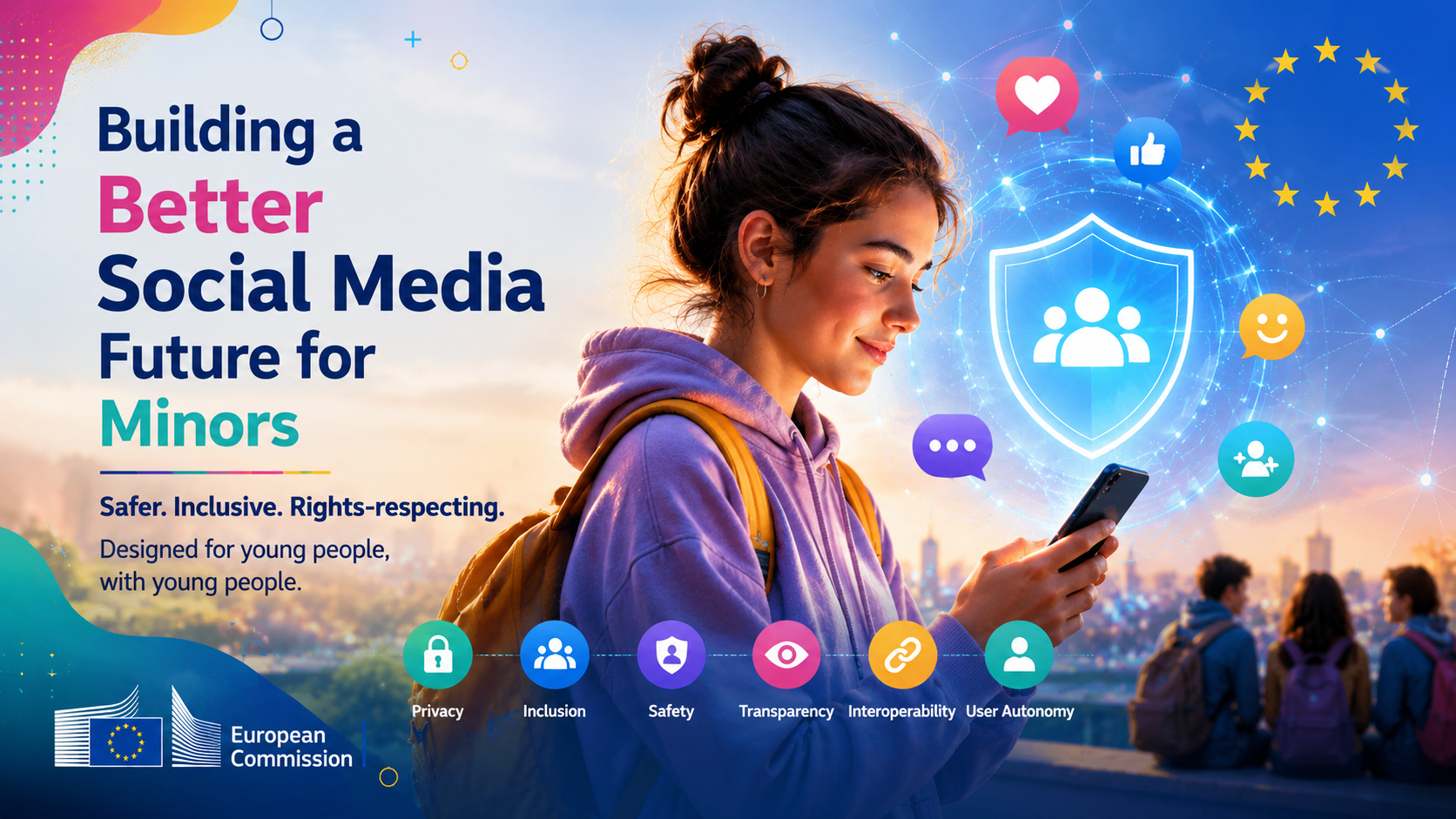
On 29 June 2026, the European Commission announced €1.48 million in funding for new ideas to make social media safer and more inclusive, especially for young people in Europe. Rather than supporting another major commercial platform, the Commission wants to see new designs that prioritize privacy, accessibility, user well-being, inclusion, and interoperability across services.
The Commission also encourages applicants to involve young people directly in the design process, ensuring that the platforms reflect the experiences and needs of those who use them most. Another notable objective is the exploration of protocol-based social media, which enables different services to communicate with one another rather than existing as isolated digital ecosystems.
Applications open on 30 July 2026 and close on 6 October 2026. Although the funding is small compared to industry levels, this initiative is more of a policy experiment than a major investment program.
From Regulating Platforms to Shaping Digital Spaces
This initiative is part of a bigger change in Europe’s digital strategy. It aligns with the EU’s Digital Decade 2030 plan, which aims to boost Europe’s innovation, reduce reliance on large global platforms, and provide more opportunities for European researchers, developers, businesses, and civil society. The Digital Decade also stresses that technology should always respect the EU’s core values: fundamental rights, privacy, inclusion, openness, and democratic accountability.
For years, public debate has centered on the problems posed by big social media platforms, such as how to handle harmful content, protect users, and make systems more transparent. These issues are especially important for children and teens, since their daily digital experiences shape how they learn, talk, and see the world.
And this is where the European Commission’s initiative strives to make a difference: Instead of adding safety and inclusion only after problems arise, it aims to determine whether these ideas can be built into new platforms from the start, especially for young users.
Importantly, the initiative is not just about whimsical and hypothetical ideas. The funded project will include practical steps:
- Working closely with young Europeans from many backgrounds, including those with disabilities and neurodivergent experiences;
- Analyzing the European social media market; developing or improving open, next-generation platforms; creating ways to encourage people to use these platforms;
- Gathering insights to help shape future European digital policy.
In short, this is not just about imagining better platforms. It is also about testing, building, and learning from them in real life.
Why This Conversation Matters
This initiative comes at a time when people around the world are debating how digital platforms affect daily life and well-being.
Researchers, educators, parents, and policymakers are asking whether features meant to boost engagement, such as endless scrolling, personalized recommendations, and constant notifications, might lead to overstimulation, shorter attention spans, or unhealthy online habits. These worries are even greater for children and teens, who may lack the skills to navigate these persuasive digital environments.
Privacy advocates say users need more control over their personal data and digital identities. Accessibility groups point out that many online services are still hard to use for people with disabilities. Others in digital rights argue that too many users are stuck on a few big platforms, and that making services work together could create a more open and user-friendly digital world.
In this context, the Commission’s proposal does not try to solve all these problems at once. Instead, it puts them at the heart of early platform design, where choices about safety, inclusion, and user experience are made before platforms reach millions of users.
Opportunities and Important Questions
Supporters of the initiative see several reasons for cautious optimism.
A social media platform built for privacy and well-being, not just engagement or ads, could give users more control over their online lives. Including young people in the design process can help make sure platforms meet real needs, not just guesses. If these new approaches work, users could move between services more easily without losing their communities or digital identities.
For digital rights advocates, this proposal matters because it shifts the focus from just regulating current systems to imagining new ones. These new platforms could have transparency, accessibility, and user control built in from the start, rather than added later.
However, important questions remain.
- Is the funding sufficient to build new systems from scratch, especially given the huge influx of investment in big tech companies? Maintenance of platform infrastructure and constant innovation require adequate financial support.
- Developing new social media platforms is an amalgamation of both technical and social tasks. Since strong network effects keep people on established platforms, the crucial question is how new alternatives can attract and retain users.
- There are also still questions about how these platforms should be governed. How can publicly supported social media balance free speech while protecting users from harm? What moderation methods best support both safety and rights? Can open, connected platforms offer the smooth experience users expect from commercial services?
These questions do not have easy answers, but they are central to the future of digital spaces.
Looking Beyond Europe
Although the initiative originates within the European Union, its relevance extends far beyond it.
Currently, discussions around online safety, child protection, artificial intelligence, and platform accountability are increasingly shaping national and international policy debates globally.
From this perspective, the Commission’s call for proposals raises an important question: should public policies regarding digital spaces be more proactive than reactive to harm once it emerges? It asks if policy should help build digital spaces that reflect shared values.
It will evidently take a long time for the results to be reflected. Social media is shaped by technology, human behavior, money, and culture. Changing just one part of the system probably will not change everything right away.
Still, this initiative is an important change in thinking. For years, the focus was on managing the problems of current platforms. Now, people are asking: what would social media look like if it were designed from the start to serve users better?
It may take time to find the answer. But simply asking this question and inviting researchers, designers, young people, and civil society to join in could be one of the most important steps in shaping the future of digital spaces.
0 comments on “European Commission’s Call for Better Social Media Platforms for Minors”