
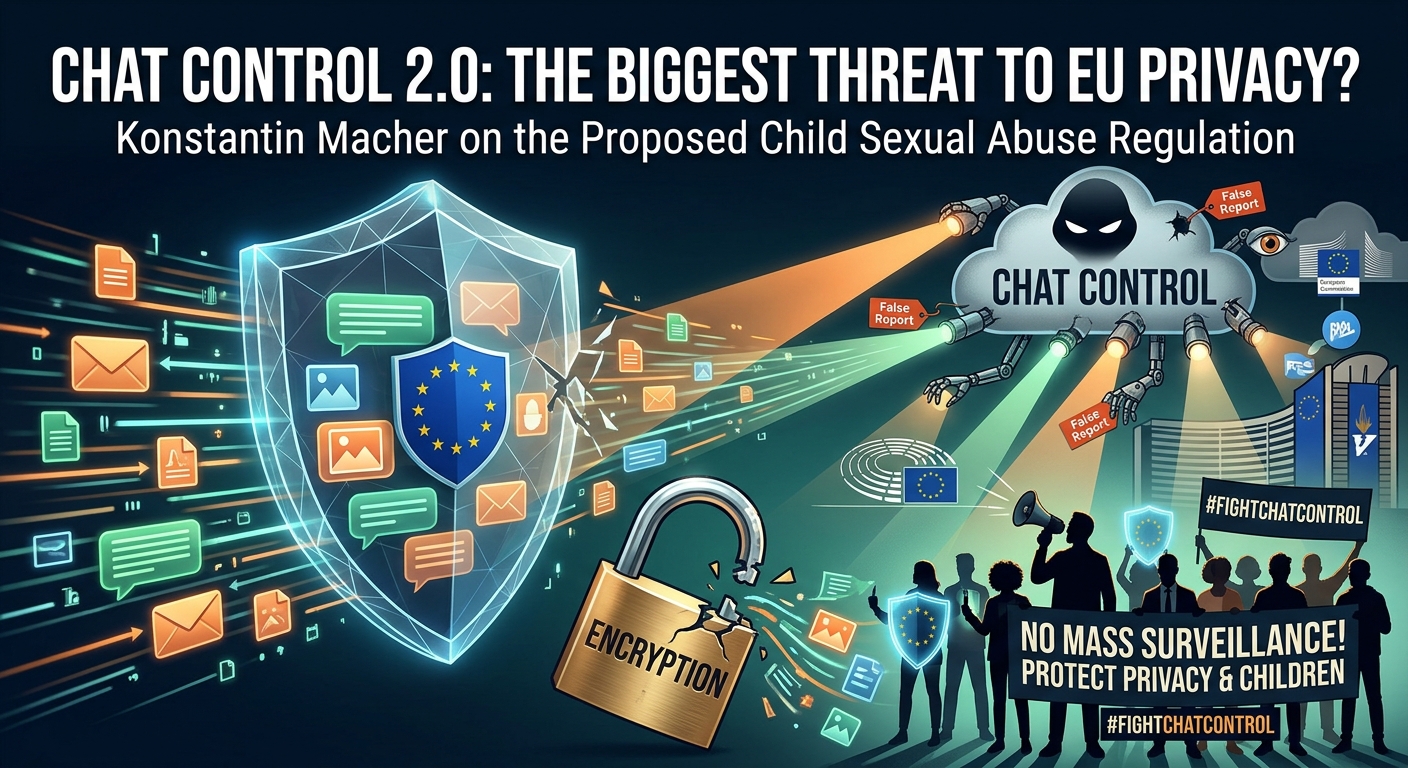
Konstantin Macher on the EU’s proposed child sexual abuse regulation, ineffectiveness, economic ties, the influence of the right-wing, protests in stadiums, and the hope for the future.
What is Chat Control, and why has the EU’s proposed Child Sexual Abuse Regulation (CSAR) sparked such fierce debate? Konstantin Macher, a political scientist, digital rights activist, and board member of the German non-profit organisation Digitale Gesellschaft, explains why he believes the proposal threatens privacy, freedom of expression, and secure communication.
In this interview with the European Pirates, Macher discusses the effectiveness of existing voluntary detection measures, concerns about false reports, the role of technology companies and commercial interests, and the political debate surrounding Chat Control. He also explains how civil society has mobilised against mass surveillance and why he remains hopeful about the fight for digital rights.
The challenge, he argues, is to protect children from sexual abuse without compromising the fundamental rights of everyone who uses digital communications.
Approachable and kind, Macher’s demeanor stands in contrast with the pressing gravity of his everyday work. We met at the EDRi privacy camp, where he stood out as an expert on Chat Control, having worked on the file since its inception. The political direction of Europe has changed, we agreed, and it is time we collaborate across organizations with similar values to resist rising political challenges.
Why does Chat Control Matter?
Why does Chat Control matter? His answer got right to the heart of it: Chat control would threaten the European Union’s core values and those of its societies. “Values such as privacy, values such as freedom of speech and the free press.”
“It would mean that everyone’s private messages could be subjected to mass surveillance”
He went on to explain, “It would mean that everyone’s private messages could be subjected to mass surveillance, and it doesn’t take much creativity to imagine how that could be abused for all kinds of purposes.” Now, of course, the issue of the protection of children and adolescents from online sexual abuse is of paramount importance to the European Pirates as much as to the Digitale Gesellschaft, to Macher, and to any sensible adult. Children can and should be protected more effectively. However, if we look at the numbers, we’ll see that the current implementation of Chat Control 1.0 is not working. As Macher put it, “In a time where most people’s communications are online, this is an infringement on our rights that’s simply disproportionate and would not even achieve its purpose.”
Does Chat Control work? What does the evidence show?
But let’s dive deeper into the results we have so far. We have statistical data on the effectiveness of Chat Control 1.0 from a report by the European Commission and mandated by the European Parliament. “What they found is that the technologies used are very error-prone. We’ve seen error rates reported in the European Commission’s own files that can be somewhere between 13% and 20%. And now imagine police trying to investigate serious crimes like they’re supposed to do and being spammed with so many false reports. That’s not helping anyone at all.” The Commission cannot prove the effectiveness of Chat Control, nor that it is proportional. As Macher put it, what “we can show with absolute certainty is that this is an interference with fundamental rights.”
“It’s mostly US companies that are using the temporary Chat Control derogation”
Palantir, Big Tech and the questions surrounding Chat Control
Ineffectiveness is not the only disturbing element of Chat Control. Recently, Arvid Grange reported that Palantir is analysing the European data scraped via Chat Control. Specifically, after conversations are scraped, Palantir’s software analyses the generated reports. “Obviously, there’s a lack of transparency about how exactly this kind of cooperation with Palantir is working,” commented Macher. This strengthens the case for scrutinising beyond what platforms scan, into who receives the resulting reports, what software is used to analyse them, what happens to the data, and whether the transfers comply with EU law. “It’s definitely scary,” he continued, “we’ve seen that it’s mostly US companies that are using the temporary Chat Control derogation so far. We’ve seen them being the strongest voice lobbying for this law in the EU. So is this really in the interest of the citizens of the European Union? Or is this something that’s basically a favour to US big tech? I don’t think it is a good idea to expose European citizens’ personal data en masse to these kinds of actors.”
It seems that Chat Control might not be as effective in protecting children as it is in delivering revenue and data to American corporations. “I can’t remember any other file that has been so scandalous in terms of questionable mixes or conflicts of interest and unusual procedures,” Macher commented. The file was indeed promoted through a tightly connected network of technology companies, lobbyists, advocacy groups, philanthropies, and EU officials, repeatedly raising questions about commercial self-interest, revolving doors, transparency, and the quality of policymaking.
Is the right-wing really claiming Chat Control?
We asked Macher how right-wing voices are changing the discourse around Chat Control. He started with a rightful disclaimer: “Digitale Gesellschaft” – the NGO that Macher represents – “does not align with any specific political party, but we are aware of the different takes of different parties on this file.” He continued: “Right-wing parties are picking up the topic of chat control more actively. […] But in the past we’ve also seen far-right actors in the European Parliament condoning the idea that chat control should be expanded. Talking then about migration, talking about drugs, even going as far as suggesting that drag queens should be found via tools like chat control.” However, there’s a difference between jumping on a visible topic and actually working on a file. “Personally,” Macher added, “I doubt that this is a credible development. From what I hear from within the European Parliament, not every group that is loud online is also active in the technical meetings.”
“Let’s not rely on what we think could be a benign dictator”
Macher then continues, making his way to a fair argument: political currents will inevitably change, so laws that touch directly upon democracy and freedom should only be passed if the constituency feels comfortable with any type of government having such laws as tools. “I would say let’s only pass laws that we would feel every government comfortable with having, whether it’s one that we trust more or one that we trust less, because we don’t know who’s governing tomorrow. So let’s not rely on what we think could be a benign dictator.” This means not passing more than what is necessary, nor anything that could turn into a slippery slope from safety to state control.
How civil society is fighting Chat Control
Within this context of American corporate interests and changing tides in the European political landscape, Digitale Gesellschaft is a crowdfunded non-profit and an independent voice. As Macher explains, with a proud and hopeful tone, “some people are taking action in our protests, some people are participating in petitions, sending emails to members of the European Parliament, some people are helping us with donations, which helps us have a small number of staff members to basically follow the file in detail in Brussels and in Germany, to then inform our supporters and the broader public about it.” And with a smile, he adds: “We are a lot of nerds that are trying to help politics understand what chat control really means.”
As we’ve seen above, the file has a history of scandals and controversies. But the mobilization of civil society against it has already achieved a lot. It is worth pointing out that the November 2026 negotiations come with good chances that legislation will favour democracy. As Macher pointed out: “I think we’ve achieved quite a lot already, and I sometimes hear people feeling frustrated by this process, and I totally get why. But we’ve also seen a civil society that is willing to take a stand and be loud.”
“We’ve seen such a diverse range of actors coming together, and that’s something beautiful.”
He continued: “Five years ago, people told me, well, no one will understand this encryption and AI surveillance tools, that’s too complicated, you can’t explain that to anyone. But we’ve managed to, and we’ve seen protests from soccer stadiums, in the streets, and even backlash from pharmacy-distributed consumer health magazines in Germany.” It would be fair to guess that Germans, out of all Europeans, might have a deep understanding of the perils of surveillance, given the country’s history of both left-wing and right-wing authoritarianism. The protests reflected longstanding concerns among organised football supporters about surveillance, privacy and civil liberties. Medical watchdogs, instead, have warned of possible intrusions in doctor-patient communications. Indeed, as Macher says, a technical, intangible problem is being effectively translated into the everyday lives of people. “We’ve seen such a diverse range of actors coming together, and that’s something beautiful.”
“The European Parliament just recently had a majority against chat control, the temporary thing passed with procedural tricks, but there is a clear majority, and the European Parliament is more firm than it has ever been, so I do believe that we have a good fighting chance in this and it’s worth continuing the fight,” he concluded.
As we parted to delve back into our respective advocacy work, we shared a mixed sense of frustration and hope. Something that many non-profits and civil society organizations share and that unites us in advocating for a free, fair, and transparent internet.
You can track the latest on Chat Control and the Regulation to Prevent and Combat Child Sexual Abuse on the landing page of Fight Chat Control.
The European Pirates’ position on Chat Control
The European Pirates defends digital rights, privacy, and freedom of expression across Europe. We support effective measures to protect children from sexual abuse. Children can and should be more protected. We also believe such measures must respect fundamental rights.
Our MEP, Markéta Gregorová, has opposed extensions and permanent versions of Chat Control that are incompatible with the right to private correspondence. The European Pirates will continue to advocate for targeted, proportionate approaches that protect children without undermining secure communication.
If you share our vision, it’s time you get involved.
0 comments on “Chat Control 2.0: Why the EU’s Proposed Child Sexual Abuse Regulation could be one of the biggest threats to privacy that we’ve seen in the European Union.”