As part of its digital sovereignty drive, the European Commission is currently inviting public input on the future of European Open Digital Ecosystems through an open consultation. The idea is to gather perspectives from different parties – developers, civil society, policy makers, public administrators, and industry insiders and ascertain how it could establish and shape the foundations of Europe’s digital future.
The European Pirates will take this opportunity to submit a response to the commission’s call. The discussion below is a starting point for that wider reflection. It outlines key ambitions of the EU’s open digital strategy and highlights several structural bottlenecks that deserve careful attention as Europe defines its next steps.
Amid rapid transformations and politically charged ramifications in the global digital landscape, the European Union has decided to restructure and strengthen its open-source digital ecosystem strategy. Over the past few years, digital infrastructure has quietly become a geopolitical asset. Cloud systems, AI models, data pipelines, and even open-source software now shape economic power, security posture, and democratic resilience. The European Commission initially adopted the strategy in 2020-2023. The call to action is amplified at the Summit on European Digital Sovereignty in Berlin in November 2025.
The underlying idea is simple: Achieve and maintain Europe’s digital sovereignty.
Key Goals Of The Initiative:
- Digital sovereignty & independence: Help Europe reduce reliance on non-EU tech companies by making it easier to use, modify, and host digital tools within European infrastructure, giving users and institutions greater control and real choices.
- Innovation & competitiveness: Offer shared, reusable tech foundations so startups, small businesses, and researchers can build faster, experiment more, and focus on new ideas instead of starting from scratch.
- Security & trust: Open code can be examined by anyone, which makes it easier to spot problems, improve safety, and build public confidence, especially for systems used in sensitive or essential sectors.
- Economic growth: Support a stronger digital economy by encouraging collaboration, lowering entry barriers, and creating space for new European tech companies to emerge and scale.
- Standards & interoperability: Push for open technologies that work well together across Europe and connect seamlessly, rather than becoming isolated silos.
- Strategic autonomy: Strengthen Europe’s digital capabilities, particularly in areas such as AI, to ensure geopolitical independence on an ever-evolving technological platform.
History as a mirror shows that sovereignty can only be attained when something, be it a nation or a system, is built brick by brick. It cannot be purchased off the shelf as a commodity. In the face of current volatile geopolitical situations and ever-evolving technological innovations, the EU’s initiative to build a digital ecosystem is indeed a need of the hour and a duty to its citizens.
But it is essential to recognise that, though the initiative’s ambition is straightforward, it is underpinned by complex challenges. Europe is trying to build an open digital ecosystem while simultaneously operating one of the world’s most assertive regulatory environments. It wants openness without dependency, innovation without loss of control, and sovereignty without isolation. Whether these goals can coexist is no longer a theoretical question. It is now a structural one.
The initiative marks a shift away from reliance on non-European digital infrastructure toward home-grown, openly accessible technologies. But building software is easier than sustaining ecosystems. Open Source does not thrive on policy declarations alone. It survives on developer communities, long-term funding, legal clarity, and trust. In a climate shaped by AI disruption, transatlantic regulatory tensions, and growing corporate consolidation, Europe’s strategy is as much an experiment in governance as it is in technology.
The proposed framework of the EU’s Open Source Initiative works through four interconnected layers:
- Digital Governance
- Digital Infrastructures Software and Data
- Digital Products and Markets
- People
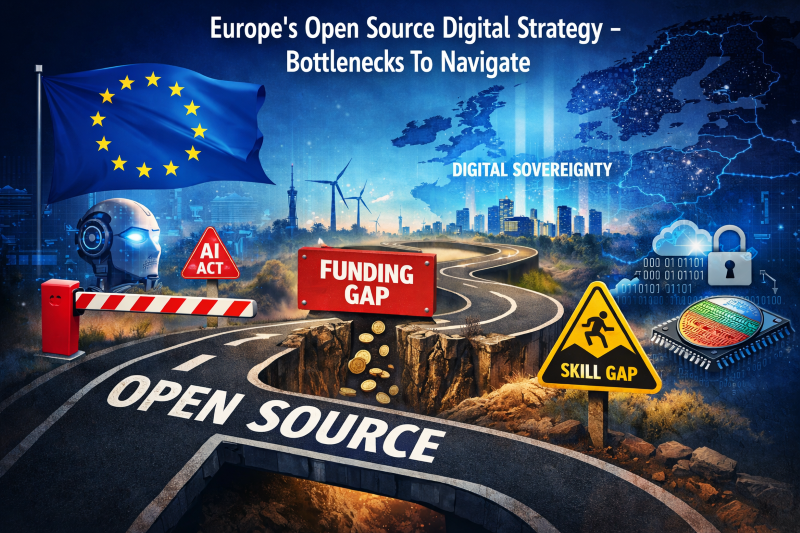
In this context, it is critical to analyse the bottlenecks that can impede the development of an open digital ecosystem in Europe. Various views have been put forth by policymakers, developers, industry leaders, and digital rights advocates. Below are a few bottlenecks that must be carefully examined and navigated:
Bottlenecks
1. Regulatory Complexity, Legal Uncertainty, and Burden On Developers
The EU’s AI Act introduces a risk-based way to govern AI. Some uses of AI are completely banned, others need strict oversight, and general-purpose AI must follow rules for transparency and safety.
The main challenge is how these rules affect Open Source projects. Vague definitions, complex requirements, and excessive bureaucracy have worried both developers and civil society groups. Smaller teams may feel discouraged—not because they oppose safeguards, but because complying with the rules may be too much for them.
Recent delays in the European Commission’s AI compliance deadlines in late 2025 demonstrate this problem. If the rules are too strict or confusing, independent developers might stop participating. If the rules are too weak, people may lose trust. Without clearer guidance and more practical expectations for open projects, these rules could slow down Europe’s digital progress by discouraging people from getting involved.
2. Funding Gaps and Ecosystem Support Challenges
Beyond being a cornerstone of Europe’s digital sovereignty, Open Source is a highly viable economic proposition for the EU (contributing approximately €65-95 billion annually and $8.8 trillion globally). But Open Source remains underfunded relative to traditional infrastructure.
This highlights significant gaps in strategy and funding within Europe’s Open-Source ecosystem. Many organisations lack clear plans or long-term investments in Open Source, making it harder to sustain projects and remain competitive.
In this context, it is crucial to pay attention to the EU’s position on digital products and markets. For instance, the global generative AI landscape is dominated by China and the US, with 60% and 12% share, respectively, while Europe ranks third with just 7%. Interestingly, Europe produces 21% of research papers worldwide, but its share of patent filings remains at 2%. The gap is due to the lack of access to venture capital.
Europe is heavily dependent on non-EU countries for critical raw materials and semiconductors. Such heavy reliance on external producers makes the supply chain vulnerable to supply chain disruptions and geopolitical pressures. Without a robust industrial base and competitive markets, the idea of digital sovereignty will remain a far-fetched dream.
3. Harmonising Policy and Technical Implementation
It is essential to recognise that the open-source initiative is not only about passing laws. It is about building systems people are expected to use.
The bottleneck arises when laws, funding mechanisms, and public technology projects become misaligned. If policies advance faster than practical tools, developers are left uncertain. If systems are built without legal and social clarity, adoption slows.
Open Source grows through steady collaboration. It depends more on continuity than on declarations. When coordination weakens, Europe risks producing strong frameworks that struggle to take root beyond official documents.
4. Addressing Cybersecurity Regulation Without Excluding Open Source
Secure networks and compatible systems to software, hardware, data networks, and cloud infrastructure are the mainstay of digital sovereignty that Europe strives to achieve.
- The Digital Decade Policy 2030 is focused on improving connectivity across the continent.
- The EU’sCyber Resilience Act (CRA) aims to improve the security of digital systems.
- A proposed €300 billion investment is in the pipeline as part of the Eurostack initiative, which aims to integrate cloud services, the AI Continent Action Plan, new AI Factories, and shared data spaces into a unified European digital infrastructure.
Despite these efforts, structural weaknesses persist, and cybersecurity remains a significant concern. Fragmentation is another challenge. If EU countries do not work together, they might continue to develop separate, incompatible data-sharing systems. This would make it harder to create a unified European data space.
Digital infrastructure and data systems are key to Europe’s digital future. They support governance, markets, and the protection of individual rights. But sovereignty is not just about having technology. It also means Europe must be able to create, store, manage, and use data in ways that reflect its values.
At this moment, as Europe seeks to shape its digital future, it cannot outsource its strategic technology layers. Digital sovereignty cannot be achieved by focusing solely on the application. Priority investment is needed in foundational systems such as:
- Secure networking and VPN tooling
- collaborative productivity platforms
- web and application security infrastructure
- data-centre orchestration and virtualisation layers
5. Skill Gap and Lack of Trust
According to the Commission’s second annual report on the State of the Digital Decade, only 55.6% of Europeans had basic digital literacy. Public trust in EU policies concerning the protection of online rights stands at 45%. This gap of skill and public trust is a matter that needs to be examined critically.
Many people still feel unsure about technology and unconvinced that their rights are truly protected online. When digital policies feel distant, complex, or designed only for experts, people can feel excluded. That loss of trust can quietly weaken Europe’s digital ambitions.
This human side shows that digital sovereignty is more than laws and systems. It is about ensuring people feel confident, included, and able to join the digital world. Without this, even the best strategies risk being about people instead of truly serving them.
Ecosystem and Infrastructure Realities
Beyond geopolitics and regulation lies a quieter layer where Open Source actually lives.
Most projects are maintained by individuals or small teams. This creates vulnerabilities that no sovereignty strategy can ignore.
Critical tools often depend on only a few people. When they burn out or move on, systems falter. Enterprises hesitate to rely on software without clear responsibility structures. When problems arise, there is often no obvious place to turn.
This does not undermine openness. It undermines resilience.
Contribution pathways face similar strain. Companies often want to return improvements to the broader community. Yet limited maintenance capacity, slow review timelines, and project governance constraints frequently push the organisation towards considering an internal/private version. Once that happens, the incentive to contribute back erodes, fragmenting ecosystems and increasing maintenance burdens across the board.
The obstacle here is not motivation. It is the absence of institutional scaffolding.
From ideology to infrastructure: what Europe would need to build
If Europe is serious about Open Source as public digital infrastructure, it must consider new structural instruments, such as:
- EU-based sponsorship platforms that reduce friction between developers and funders
- public-sector sponsorship obligations tied to software procurement
- early-stage funding mechanisms for individual maintainers
- Public-funding conditions that require open-source contributions
These are not symbolic gestures. They are the economic foundations of a sustainable open-source ecosystem.
Closing Perspective: The Value of Digital Rights Voices
As Europe navigates regulation, competition, and technological acceleration, digital rights organisations continue to stress an essential point: innovation and rights protection are not opposites.
They argue that digital policy should not only prevent harm, but also actively empower people. That means meaningful transparency, accountability, and the protection of the integrity of Open Source itself.
This perspective reframes Europe’s initiative. It is not only about market position or technological independence. It is about shaping a digital environment where infrastructure supports dignity, autonomy, and democratic choice.
Europe now faces a rare opportunity. It can build an open-source strategy that does more than produce software. It can create a digital public space where innovation is structurally supported, and rights are structurally protected.
Pingback: Europas Open Source Digitalstrategie - Navigation Durch Flaschenhälse - Flaschenpost
Pingback: Europe’s Open Source Digital Strategy – The Pirate Perspective – European Pirates
Pingback: Beyond the Tech Stack: The Pirate Vision for a Sovereign and Free Digital Europe – European Pirates