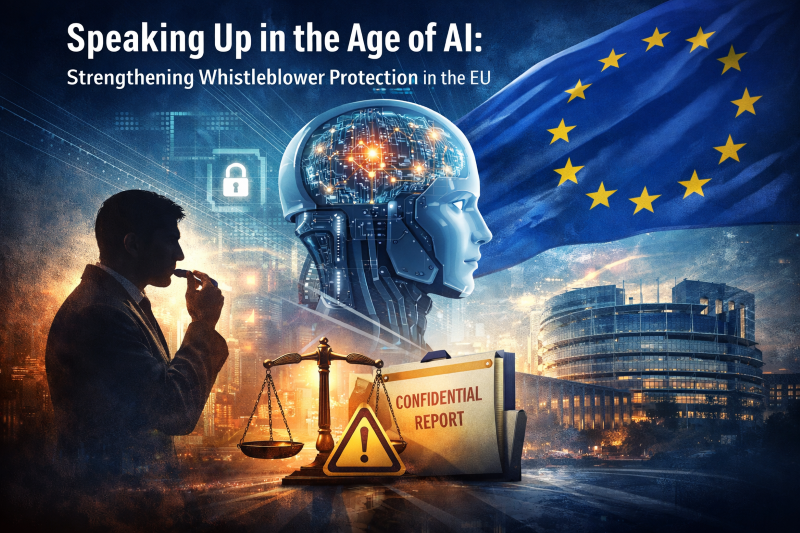
For democracy to function, voices must be heard. For justice to prevail, those voices must also be protected. When both happen, transparency and trust grow together and help build healthy societies.
At its core, the idea is simple. People, no matter their position or power, should be able to report wrongdoing without fear. This could be corruption, misuse of authority, or risks to public safety.
Such individuals are known as whistleblowers.
A whistleblower is typically an employee, contractor, or insider who exposes misconduct, illegal activity, fraud, or risks to public health within an organization or government body. Yet in reality, power structures often silence those who speak up.
Raphaël Halet’s experience shows how difficult this can be. After exposing secret tax arrangements that benefited multinational corporations, he was convicted of a crime. He spent nearly a decade in legal battles before being cleared by the European Court of Human Rights in 2023.
Even more stark is the case of Daphne Caruana Galizia, who relied on whistleblowers to uncover systemic corruption in Malta. Her pursuit of the truth ultimately cost her life.
These cases reveal a hard truth. Without real protection, speaking up can come at a very high personal cost.
In response to this chilling effect, the EU Whistleblower Protection Directive was introduced. Its goal is to ensure that people who report wrongdoing are protected through secure reporting channels and safeguards against retaliation. Protecting whistleblowers is not only an ethical responsibility. It is essential for building systems that people can trust.
From Traditional Risks to the Age of AI
As the European Union moves deeper into the world of artificial intelligence, the role of whistleblowers becomes even more important.
The Directive was originally designed to address areas such as financial fraud, public safety, and environmental harm. But today, technology shapes decisions across hiring, healthcare, finance, and governance. Risks are no longer always visible or easy to detect.
This is where the EU AI Act comes in. It sets out rules for how AI systems should be designed, deployed, and monitored, especially in high-risk areas.
The relationship between the Directive and the AI Act is both practical and necessary. AI systems are often complex and difficult to understand from the outside. Regulators cannot always see how decisions are made. Insiders, however, can.
Developers, engineers, and contractors are often the first to notice problems such as biased algorithms, unsafe design, or misuse of AI tools. The Directive ensures that these individuals are protected when they speak up. The AI Act ensures that what they report is legally recognized and actionable.
By including AI-related problems and supporting safe ways to report them, the EU is doing more than just updating a law. The EU is reflecting on the fact that accountability today relies on protecting people who raise concerns from within organizations.
Together, these two frameworks create a strong foundation.
At this point, it is important to note that, from a policy perspective, integrating the Whistleblower Protection Directive and the EU AI Act offers hope for stronger compliance with rules and more transparent systems. But effective and uniform implementation requires deeper introspection.
According to the report adopted by the European Commission on 3 July, 2024, there remains a gap between what the law promises and what people experience in practice.
1. Retaliation Protection and Fundamental Rights
The Directive promises strong protection. Whistleblowers should not be dismissed, demoted, or harassed for speaking up. Employers must prove that any negative action is unrelated to the disclosure.
In reality, this protection is uneven.
Across EU Member States, enforcement varies. Some systems work well, while others are harder to access. This inconsistency weakens trust.
Retaliation is not always obvious. It can take the form of stalled careers, damaged reputations, or workplace isolation. These effects are difficult to prove but deeply felt.
Enforcement also remains a challenge. Authorities may lack resources or technical expertise, especially in complex AI cases. When retaliation is unlikely to be punished, protection risks becoming symbolic.
The Directive protects whistleblowers from being held responsible for acting in the public interest. But with AI, there are grey areas. Some risks might not break the law but can still cause harm. This makes people unsure if they are protected when they raise ethical issues.
At a deeper level, whistleblowing is tied to fundamental rights such as freedom of expression and access to information. When someone is silenced, the public loses access to important truths.
The AI Act recognizes this role, but in practice, retaliation is still often treated as a workplace issue rather than a broader democratic concern.
2. Scope in the Digital and Technology Sector
Extending protection to AI is a necessary step, but it also highlights new challenges.
From August 2026, violations of the AI Act will clearly fall within the Directive’s scope. This extends protection to employees, contractors, and self-employed individuals working with AI systems. Secure and anonymous reporting tools have also been introduced.
However, gaps remain.
AI risks can spread quickly. A flawed system can affect thousands of people at once. Bias can be repeated automatically without being noticed.
Many risks appear before any law is broken. For example, an AI system may rely on biased data or flawed testing. These issues may not be illegal, but they can still cause harm.
This creates uncertainty. Those who identify early risks are often unsure whether they are protected if they report them.
There are also limits on who is covered. Researchers, auditors, and civil society groups play an important role in identifying risks, but they are not always fully protected.
This creates a clear gap. Those best placed to detect problems are not always adequately protected when they speak up.
3. Transparency, Awareness, and Accessibility
Legal protection only works if people know about it and trust it.
The Directive requires organizations to establish mechanisms for reporting problems, but these systems are not always clear or easy to use. Some employees worry their identity will be revealed. Others do not know what happens after they report something. This uncertainty makes people less likely to speak up.
The AI Act introduces new tools that improve confidentiality and access. However, full protection for AI-related disclosures will only clearly apply from August 2026, leaving a period of uncertainty.
Non-traditional workers face additional challenges. Contractors, freelancers, and self-employed individuals are included in the law, but often lack formal reporting structures. Many depend on short-term contracts, which makes speaking up riskier.
Delays in implementing the Directive across Member States have also affected trust. Uneven adoption has led to confusion and reduced awareness.
When laws are not applied consistently, people are less likely to rely on them.
Conclusion: From Legal Framework to Real Protection
The European Union has created a strong legal framework by aligning the EU Whistleblower Protection Directive with the EU AI Act.
The challenge now is making it work in practice.
This requires consistent enforcement, stronger institutional support, and greater awareness. Protection should also cover new risks, not just clear legal violations. For example, AI systems might unintentionally discriminate in hiring, reinforce bias in healthcare, or make decisions that cannot be explained. These problems may not break the law, but they can still cause harm.
Reporting systems must be easy to access and trustworthy. Most importantly, retaliation must be treated as a serious issue that affects not just individuals’ but public trust.
In a world shaped by complex technologies, accountability often depends on individuals willing to speak up.
Protecting them is not just good policy. It is essential for the future.
Pingback: Strengthening Whistleblower Protection in the Age of AI – European Pirates