Evolution Of the Internet
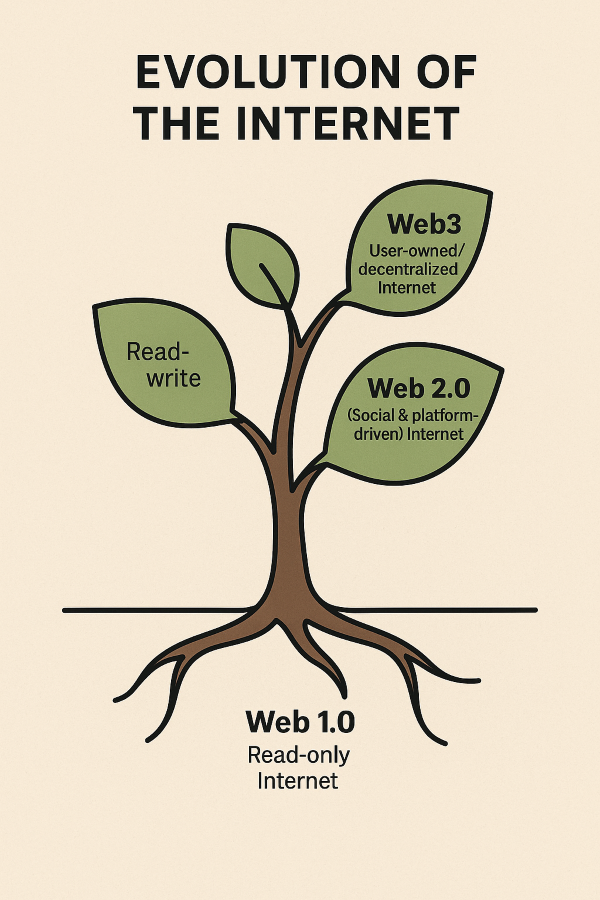
Comparing the internet’s growth to Darwin’s theory of evolution helps explain how it has changed over time, with each stage adapting to the needs, behaviours, and technologies of its time.
The initial phase, known as Web 1 (spanning the 1990s to the early 2000s), was characterised by the internet’s primary function as an information dissemination tool. During this period, only site owners managed content, resulting in a read-only experience for users and a unidirectional flow of information similar to a digital brochure.
Tim O’Reilly introduced the term “Web 2.0” in 2004, marking a new era as mobile services expanded, broadband connectivity improved, and technologies such as AJAX and HTML5 emerged. The internet became interactive, enabling users to create, share, and engage with content without needing special skills. This change opened new ways for people to communicate and connect worldwide.
But as Web 2.0 grew, a few big companies gained significant power and control over data. They decided how information was shared, which voices were heard, and how personal data was handled. Algorithms control every piece of information and opinion. At the same time, many of these platforms rely on business models that depend on extensive data collection, with user behaviour fueling targeted advertising. While these services often appear free, the trade-off is a gradual loss of privacy, autonomy, and control over one’s digital presence.
Concerns about this central control, privacy, and reliance on these platforms led to the idea of a new kind of internet, now called Web 3.0.
What is Web 3.0?
The internet is now moving toward a more user-focused phase, where data ownership is decentralised. Web 3.0 uses technologies such as blockchain and the Semantic Web to return control of data and digital assets to users rather than large technology companies. This change aims to enhance the transparency, security, and personalisation of online experiences.
Key Characteristics of Web 3.0
1. Decentralisation
Control is shared across networks rather than held by a single company or authority. This means that people need not rely on centralised platforms as much.
2. User control over data and identity
Users have more control over their digital identities and personal data, rather than giving that control to platforms by default.
3. Reduced intermediaries
Web 3.0 aims to cut out intermediaries by enabling people to interact, share, and make transactions directly, without needing a central platform to manage these actions.
4. Transparency by design
Many Web 3.0 systems are designed to make rules, transactions, and changes open and verifiable, rather than hidden within private systems.
5. Permissionless participation
Anyone can participate without approval from a central authority, provided they comply with the network’s rules.
6. Resilience and censorship resistance
The distribution of data and services increases the difficulty for any single entity to shut down platforms or completely silence users.
People often use the term Web 3.0 to refer to technologies such as cryptocurrencies, tokens, or blockchain-based finance. However, the main features listed above also make Web 3.0 useful in many areas, including supply chain management, gaming and the metaverse, healthcare, content creation and social media, intellectual property, and digital identity.
How Does Web 3.0 Work – A Brief Sneak Peek
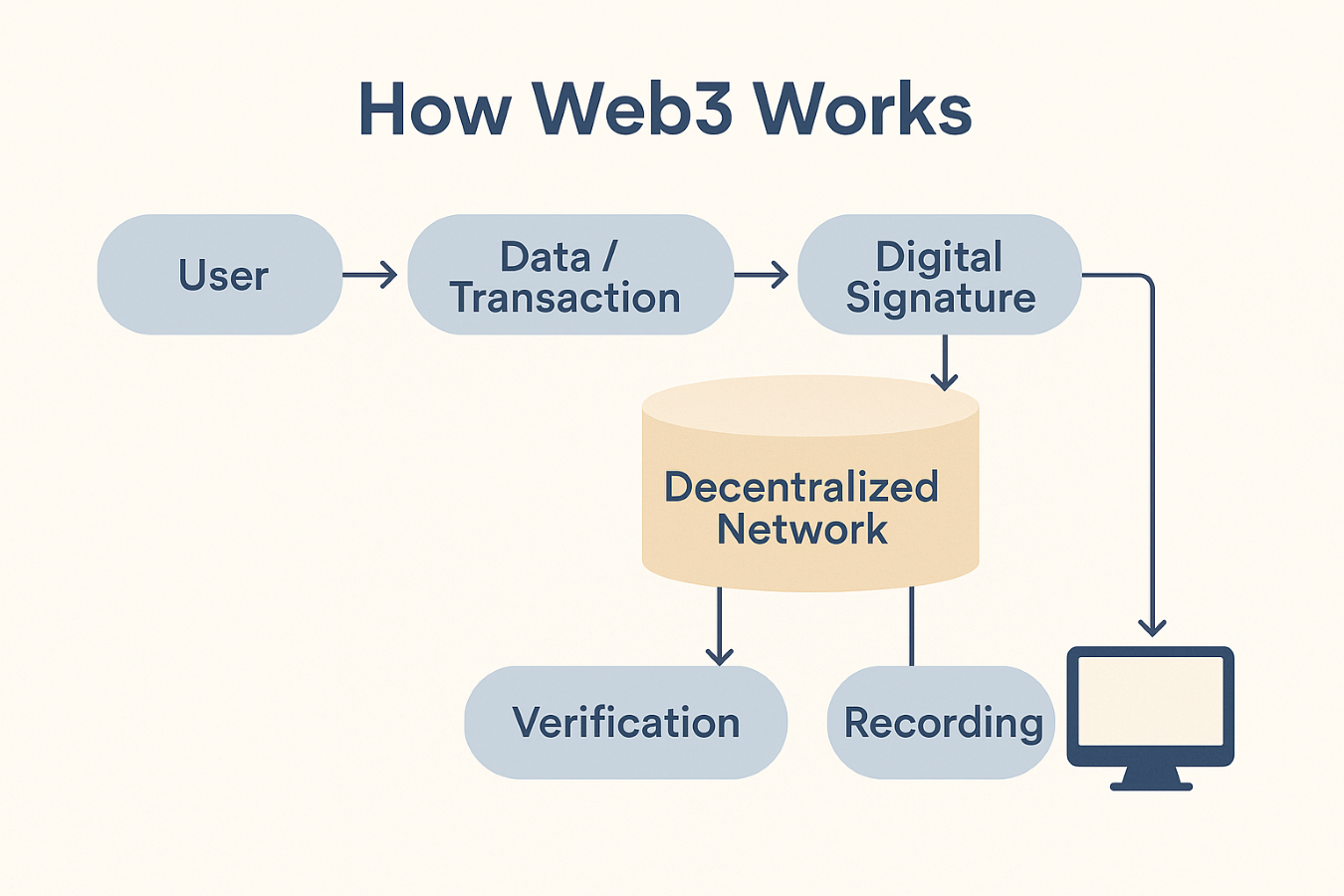
At its core, Web 3.0 changes how information is stored and managed. Instead of storing data on servers owned by a single company, information is distributed across networks. The action is cryptographically signed by the user, verified by multiple participants, and recorded in a shared ledger that is difficult to alter. This structure reduces reliance on central intermediaries and makes manipulation or data abuse more difficult, while shifting greater control and responsibility to users. Although the technology driving Web 3.0 is complex, the primary goal is simple: to give users greater control and responsibility.
Web 3.0: An Emerging, Yet Unsettled, Part of the EU’s Digital Vision
Freedom, Democracy, and Respect for human rights have been the core pillars of the European Union since its inception. These principles have been a centre of discussion whenever policies are framed, and the digital space is no exception. The European Union has signalled a clear willingness to invest in the development of Web 3.0-relevant technologies through official strategies, infrastructure development, and research funding. The European Union is actively shaping the digital world by protecting users, ensuring fair competition, and defending fundamental rights.
A Few Examples:
- The Commission’s blockchain and Web3 strategy outlines policy support, funding programmes, and legal frameworks to foster innovation in decentralised systems.
- Web 3.0-aligned technologies are being evaluated for identity and credential management and secure data exchange.
- EU funding programmes support projects on decentralised data, privacy-preserving technologies, and interoperability. (In recent times, 2016-2019, the EU invested 180 million Euros in a project called Horizon Europe, with grants expected to flow in the future as well)
Web 3.0 Is Still A probability, Not A Concrete Solution Yet.
However, the EU also values legal certainty, accountability, and consumer protection, which can be challenging to achieve in decentralised systems. As a result, the relationship between Web 3.0 and EU policy is still developing, reflecting both a willingness to innovate and a careful approach to potential risks. In this light, it is imperative to understand the complications and challenges associated with Web 3.0.
Challenges of Web 3.0:
- Still in its nascent stage, the technology underlying Web 3.0 is complex and not widely known. Concepts such as private keys, smart contracts, wallets, and decentralised storage are still largely unfamiliar and challenging for non-tech-savvy users.
- Centralised platforms outperform Web 3.0 due to easier user navigation. Influencing users to shift from a seamless platform to a complex option would require substantial investment in digital education and community building, as well as time.
- Beneath the layers of immutable privacy structures, due to a decentralised mechanism for data sharing and storage, technologies such as Web 3.0 lack accountability systems. In the absence of a centralised moderation mechanism, addressing harmful or illegal content, misinformation, and responding to abuse becomes challenging. Once the content is stored, its removal becomes nearly impossible.
- Protocols may be decentralised in theory, but small groups of developers or influential participants still influence many major decisions. This can recreate power imbalances similar to centralised platforms, undermining ideals of shared governance.
- Although Web 3.0 may be emerging as a technical solution to censorship, it is critical to understand that technology alone cannot address deeper social and political issues. Issues such as governance, community norms, power dynamics, and regulatory compliance require broader approaches beyond code.
- For less experienced users, the sole onus for online security, privacy, and data management, owing to greater control, could be overwhelming.
Looking ahead: between regulation and re-imagining
As Europe debates the future of its digital space, organisations such as European Digital Rights reiterate that technology alone does not secure freedom or fairness online. ERDi firmly believes that human rights, data protection, and democratic accountability should be the core of any discussion of new digital systems. From this perspective, Web 3.0 is neither a solution nor a threat in itself, but offers a new avenue of technological experimentation that must operate within existing legal frameworks and fundamental rights.
In the current political landscape, EU initiatives such as the Digital Services Act, the Digital Markets Act, and ongoing discussions around chat control and the Digital Omnibus reflect growing concern about platform dominance, surveillance, and the limits of the Web 2.0 model. These laws aim to correct structural harms through regulation, but also raise deeper questions about how digital infrastructures are designed and who ultimately holds power over them.
In this context, Web 3.0 can be seen as part of a broader conversation about decentralisation and user agency rather than a finished alternative. While its principles resonate with long-standing European Pirate values around privacy, autonomy, and resistance to excessive central control, decentralised technologies also risk creating new concentrations of power if left unchecked. EDRI’s cautious approach emphasises the need for civic interest control, civil society involvement, and robust safeguards.
The interaction between regulation and experimentation will likely shape Europe’s digital future. If approached critically and inclusively, discussions around Web 3.0 can help imagine an internet where innovation supports user rights, rather than undermining them.
0 comments on “Europe’s Next Digital Frontier: Balancing Web 3.0 Innovation with Fundamental Rights”