
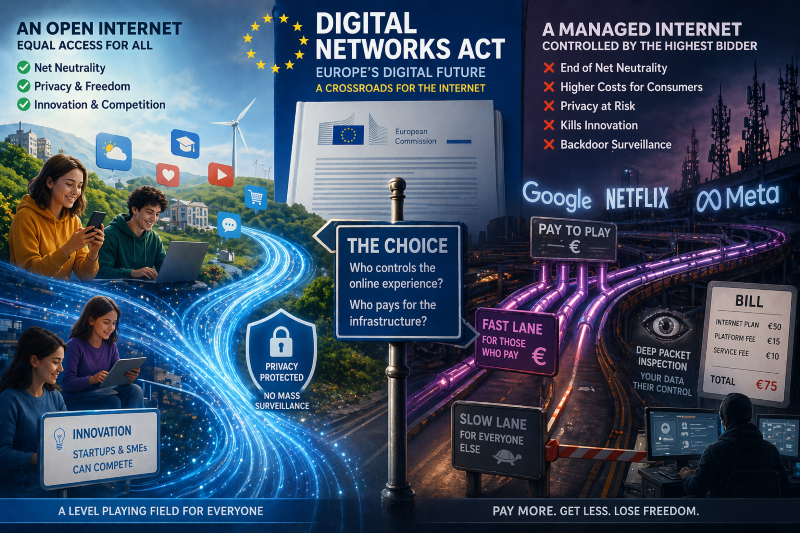
For decades, the internet has functioned on a simple and democratic principle: all data is equal. Whether the internet users are checking a local weather report or streaming a global blockbuster, the internet’s pipes treat that information the same way. However, a new piece of legislation from the European Commission, the Digital Networks Act (DNA), is set to rewrite these rules.
While it sounds like a dry piece of technical policy, the DNA has sparked a massive firestorm involving tech giants, telecom companies, and digital rights activists. At its core, the debate is about who controls the online experience and who pays for the infrastructure that makes it possible.
What is the Digital Networks Act?
The Digital Networks Act is a sweeping legislative proposal designed to modernize Europe’s telecommunications sector. Think of it as a massive renovation project for the continent’s digital highways. The goal is to ensure that every home in Europe has access to ultra-fast gigabit internet and 5G by 2030.
To achieve this, the Act proposes changing how internet service providers (ISPs) operate, how they are regulated, and, most controversially, how they interact with large content platforms such as Google, Netflix, and Meta.
The Vision: Why Policy Makers Support It
European policymakers argue that the continent is falling behind the US and China in digital infrastructure. They believe the current system is broken because a handful of massive Big Tech companies generate the majority of internet traffic but do not pay for the physical cables and towers that carry it.
Supporters of the Act believe that by allowing telecom companies to consolidate and find new revenue streams, Europe will finally have the sovereignty and cash flow needed to build a world-class network. They see it as a way to create a fairer digital economy where the companies profiting most from the internet help foot the bill for its maintenance.
The Growing Chorus of Opposition
While the goals of a better internet sound great, the methods proposed in the DNA have triggered a massive backlash from civil society groups and digital rights advocates. Groups like European Pirates, European Digital Rights (EDRi), and various consumer watchdogs warn that the Act hides several poison pills that could permanently change the internet for the worse.
Here are the primary reasons why activists are sounding the alarm:
1. The End of Net Neutrality
The biggest concern is the potential death of Net Neutrality. This is the rule that prevents the internet providers from slowing down or blocking specific websites. Critics argue that the DNA introduces dispute-resolution mechanisms that are just a fancy way for ISPs to charge websites a toll to reach users.
If a website does not pay, the ISP could technically slow down its traffic. This creates a pay-to-play environment. For a student or a small business owner, this means the next great app or social platform might never succeed because it cannot afford the entry fee to be in the fast lane. The internet would stop being a level playing field and start looking like cable TV, where the subscriber/user only sees what the provider allows.
2. The Double Tax on Consumers
Digital rights advocates point out a major flaw in the fair share argument. If big platforms are forced to pay billions of euros to telecom companies, they are not just going to lose that money. They will pass those costs directly to the customer.
If the users are already paying for their internet service provider (ISP) for an internet connection. If the DNA goes through, one might see subscription prices for platforms like Netflix or Disney rise to cover the new network fees. Essentially, the consumer would be paying for the same internet twice: once to get the connection and once to use the services.
3. Privacy and Mass Surveillance
To manage fast lanes and slow lanes, internet providers would need to become much more intrusive. Currently, the internet service providers mostly move data from point A to point B without looking too closely at what it is.
Under the new proposed rules, providers would need to identify exactly what kind of traffic is being sent to decide if it belongs in a priority lane. This requires deep packet inspection, a technology that allows companies to peek at user data. Activists warn that this creates a massive privacy risk and provides the technical tools necessary for government surveillance or corporate data mining.
4. The Digital Omnibus Trap
One of the most criticized aspects of DNA is how it is passed on. It is part of what critics call a Digital Omnibus, a giant bundle of different laws squeezed into a single package.
Civil societies argue this is a sneak attack on digital rights. By bundling the DNA with other technical regulations, policymakers are making it harder for the public and independent regulators to scrutinize the fine print. Over 120 organizations have warned that this streamlining could weaken existing laws that protect our data privacy and ensure that Artificial Intelligence is used ethically, either accidentally or intentionally.
5. Killing Innovation
The internet became what it is today because anyone with a laptop and a good idea could start a website that reached the whole world. Digital rights advocates argue that the DNA protects the giant telecom companies at the expense of the future.
If the internet becomes a place where users need a team of lawyers and a massive budget just to negotiate with ISPs, the garage startup era in Europe will be over. Instead of fostering Innovation, the Act could lock in the dominance of the current tech giants, who are the only ones rich enough to pay the new tolls.
A Crossroads for the Internet
The Digital Networks Act is being sold as a technical upgrade, but the opposition from civil society makes it clear that it is actually a political choice. It is a choice between an Open Internet that belongs to everyone and a Managed Internet that belongs to the highest bidder.
As the debate continues in the European Parliament, the focus remains on whether Europe can build 5G towers without undermining the digital rights that protect its citizens. For now, advocates are clear: the price for faster internet should not be our privacy, our wallet, or our freedom to browse an open web.
Pingback: Evaluating the Digital Networks Act: The European Pirates’ Consultation Input – European Pirates